Bal Mithai — More Than a Sweet, a Taste of Kumaon
Bal Mithai — More Than a Sweet, a Taste of Kumaon
Prem Prakash Upadhyay ‘Natural’
Bageshwar, Sept 30
Long before Uttarakhand became a popular destination for travellers seeking mountain views, pristine landscapes and quiet holidays, Kumaon had another way of making visitors remember the hills—a small box of Bal Mithai.
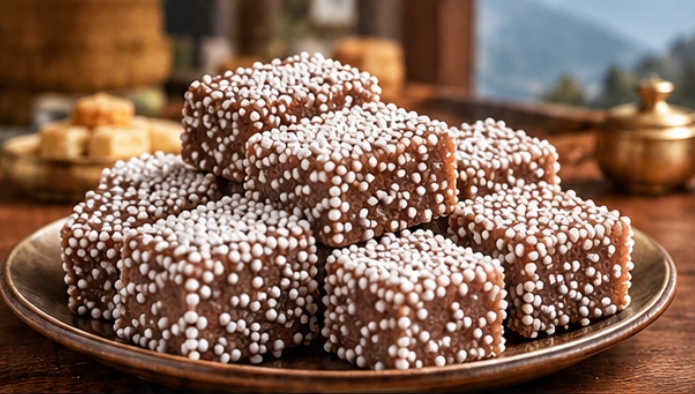
Dark brown in colour and covered with tiny white sugar balls, Bal Mithai has a distinctive appearance that is difficult to confuse with any other sweet. Made primarily from khoya and sugar, this traditional Kumaoni delicacy has remained popular across generations. But its story is about much more than taste.
For the people of Kumaon, ‘Bal Mithai’ is closely associated with home, family and local tradition. It is bought for festivals and special occasions, offered to guests and often carried by travellers returning from the hills to relatives and friends in other parts of the country.
In the traditional sweet shops of Kumaon, preparing ‘Bal Mithai’ is a skill passed down from one generation to the next. The ingredients may be simple, but achieving its familiar taste, texture and colour requires experience, patience and an understanding of the traditional method.
Over the years, the sweet has also acquired an important place in Uttarakhand’s tourism economy. Visitors looking for something distinctly local often take Bal Mithai home with them. In that sense, it has become a culinary souvenir of Kumaon—one that can be eaten, shared and remembered rather than simply displayed.
Its continuing popularity assumes greater significance at a time when many traditional foods are facing pressure from changing tastes and mass-produced alternatives. Packaged sweets and modern confectionery products are widely available, while traditional makers have to contend with rising costs, changing consumer preferences, improved packaging requirements and the need to reach wider markets.
The challenge, therefore, is not merely to preserve ‘Bal Mithai’ as an old recipe. It is to keep the tradition commercially viable while retaining the qualities that make the sweet distinctly Kumaoni.
Tourism can play an important role in this effort by connecting local food more closely with the experience of visiting the hills.
Food is often one of the simplest ways of understanding a place. Uttarakhand is widely known for its mountains, forests, temples and rich folk traditions. Its traditional cuisine tells another part of the story—one rooted in local ingredients, family practices and generations of inherited knowledge.
‘Bal Mithai’ carries that story in a particularly accessible form.
For an outsider, it may begin as a box of sweets picked up on the way home. For a Kumaoni, however, it can evoke the memory of a familiar sweet shop, a family celebration or a journey back to the hills.
Khimda Mohanda, a well-known Bal Mithai maker from Almora, believes that preserving the sweet is also about preserving the identity associated with it.
“Our generation, along with the generations to come, must know this tradition and understand why it has survived for decades,” he says.
His words underline a larger point: traditional foods survive not merely because people continue to eat them, but because communities continue to value the stories, skills and cultural identity behind them.
That is perhaps why ‘Bal Mithai’ has endured. Its sweetness may be simple, but the tradition behind it is lifelong.