Dr. Wazahat Hussain: An Octogenarian’s Lifelong Dedication to Plants
Dr. Wazahat Hussain: An Octogenarian’s Lifelong Dedication to Plants
S.M.A.KAZMI
Dehradun , Sept 30
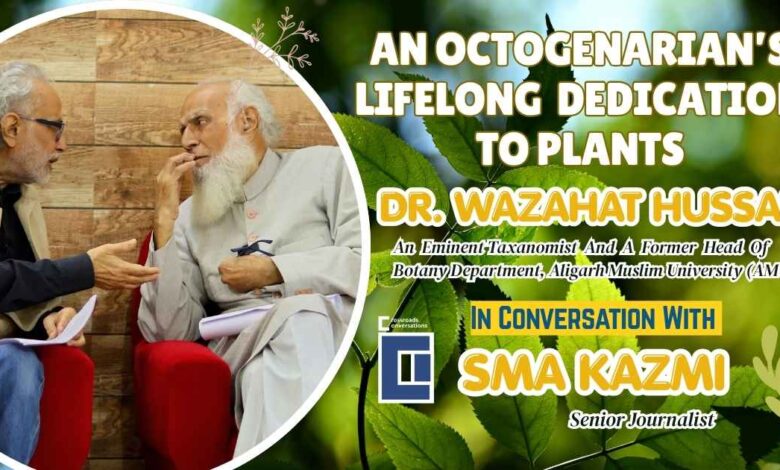
In an in-depth interview on Crossroad Conversation—a featured talk show by The Northern Gazette—eminent botanist, taxonomist, and former Head of the Department of Botany at Aligarh Muslim University (AMU), Prof. Dr. Wazahat Hussain, recounted his journey spanning nearly nine decades. The conversation covered poignant memories of pre-partition Dehradun, groundbreaking contributions to plant taxonomy, and serious warnings regarding deforestation and climate change.
Born in Manglaur near Roorkee in Haridwar district, Prof. Wazahat Hussain spent his formative years growing up in Dehradun, which he fondly remembered as a lush, tranquil, and entirely green valley. He began his early schooling at Islamia High School (now Gandhi Inter College) situated on Gandhi Road, known in those days as Viceroy Road. Reflecting on his early teachers, he highlighted how instructors instilled deep discipline, curiosity, and language proficiency right from standard three. He later completed his intermediate and B.Sc. studies at DAV College, Dehradun, before moving to Aligarh Muslim University (AMU) for his M.Sc. and Ph.D.
Prof. Wazahat Hussain shared vivid, firsthand recollections of the communal violence that erupted across Dehradun shortly after independence in late 1947. He described how areas from Paltan Bazaar to the Clock Tower were engulfed in fires and riots during September 1947. In that tense environment, the then District Magistrate Mr. A.D. Pandit and Superintendent of Police Mr. Sharma stepped in to protect civilians. A military truck with armed guards was arranged to transport the mortal remains of a local saint, Mannu Shah, safely across the Dat Kali tunnel to Piran kaliyar as per his last wishes. Manu Shah was killed during the riots. His family taking a chance also went to their native Manglaur near Roorkee for safety. Following the partition crisis, His uncle cHakim Rafat Hussain Farooqui, a respected elder and Congress leader and local officials coordinated rehabilitation initiatives, which led to the establishment of residential settlements like the Muslim Colony in Lakhibagh in Dehradun.
Under the guidance and mentorship of legendary scholars such as Prof. Som Deva Sharma and Prof. K. Ahmad Chowdhury, Prof. Wazahat Hussain devoted his professional life to plant taxonomy and floristics. His extensive 998-page doctoral dissertation on the Flora of Aligarh earned exceptional praise from his external examiner, Prof. E.J.H. Corner (FRS, Cambridge University), who described it as a monumental, learned, and encyclopedic work. Prof. K. Chowdhury weas legendary wood technology expert who createdg a unique “Wood Library” showcasing diverse Indian timber specimens.at the Forest Research Institute (FRI), Dehradun.,
For roughly 35 years between 1986 and 2017, Prof. Wazahat Hussain also taught floristic vegetation, ecology, and wildlife habitat courses at AMU and other universities and research institutes like Wildlife Institute of India (WII) on a voluntary, honorary basis without accepting any remuneration. His pioneering work on medicinal plants earned him the prestigious Sheikh Zayed International Award in Dubai/Abu Dhabi in 2022, alongside lifetime achievement honors from UGC, the Ministry of Ayush, WII, and AMU.
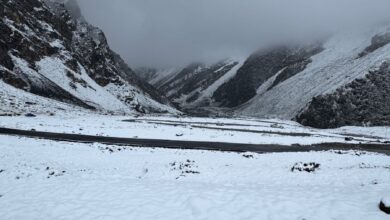
Addressing the pressing crisis of environmental degradation in the Himalayan region and globally, Prof. Wazahat Hussain sounded a strong alarm over rampant urbanization and deforestation. He recalled that in the mid-1940s, Dehradun was so dense with green cover that it received measurable snowfall, a reality now unthinkable due to escalating temperatures and ecological disruption. He pointed out that excessive commercial logging and real estate expansion have severely depleted native tree species such as Sal and Teak. Comparing trees to the planet’s respiratory system, he underscored that the Amazon rainforest serves as the primary source of global oxygen. Illustrating an insightful wordplay he often shared with his students, he noted that removing the top bar of the letter ‘T’ in ‘TREE’ and placing it in the middle turns it into ‘FREE’, signifying that trees provide free oxygen, which is essential to all life. Prof. Wazahat Hussain concluded by emphasizing that restoring green cover through conscious afforestation is the only sustainable way to mitigate climate change and protect fragile Himalayan ecosystems for generations to come.