‘Pyre’ brings the human cost of migration from hills to big screen
‘Pyre’ brings the human cost of migration from hills to big screen
B.D.Kasniyal
Pithoragarh, Nov 1
‘Pyre’, a film written, directed and produced by National Award-winning filmmaker Vinod Kapri, which has brought the deepening crisis of migration from the Himalayan region to audiences across the world, appears to have succeeded in conveying its central message: the unchecked exodus from the hills has not only paralysed the traditional economic structure of Himalayan villages but has also weakened their social and family fabric, as people are increasingly caught up in a relentless struggle for survival.
The story of Pyre revolves around an elderly couple living in a remote Himalayan village from which almost all the young people have migrated to cities in search of livelihoods. The couple has been waiting for their only son to return from the city for the past 28 years so that he can look after them in their old age. However, they live with the constant fear that if either of them dies before their son returns, there may be nobody left in the village to carry the deceased to the cremation ground. In a poignant reflection of their loneliness, the two even prepare a funeral pyre for each other near their house, so that whoever dies first can be cremated without having to depend on anyone else.
“Beyond this central theme, the film’s vision, the everyday bickering between the elderly couple and their silent expressions of pain make the story particularly engaging,” says Sudheer Rathod, a journalist from Berinag who is also associated with the film’s production team.
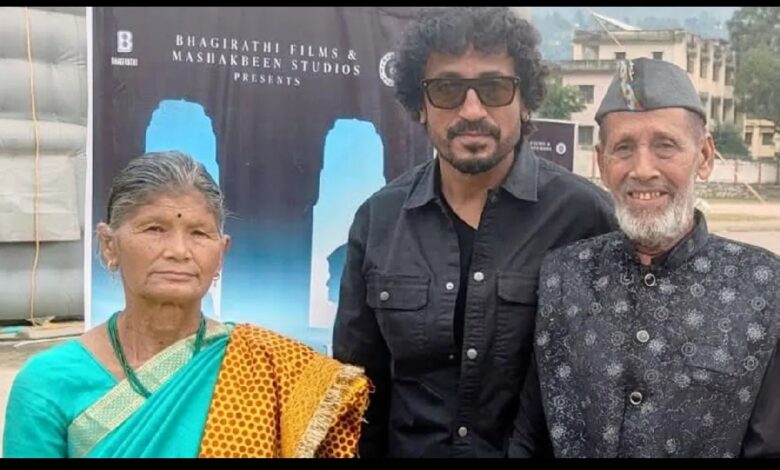
“The uniqueness of the film also lies in the performances of the elderly couple, Aama and Bubu, who were played by non-professional actors selected by the producer and trained within a short period to perform their roles convincingly,” Rathod said.
According to Rathod, the film portrays the almost 100 per cent reality of life in remote parts of the Himalayan region today, although its narrative may initially appear like a fictional or dreamlike depiction.
“Such scenes are not uncommon in our region. On some occasions, owing to the absence of young people in villages, personnel of the border security forces have had to carry dead bodies to cremation grounds,” Rathod said.
Released nationwide on October 30, the film has already earned international recognition, winning 18 awards, including 15 Best Film awards, at various film festivals across Europe, North America and Asia.
“Today, I feel relieved that my eight-year-long struggle to realise a dream and bring it before a national audience has finally borne fruit with the film’s release for the general public across the country. These eight years have taken me through different phases of dreams, struggles, disappointments and even frustration, with only occasional rays of hope that the dream of making a film on a subject that touched me so deeply would survive,” said Vinod Kapri on the film’s nationwide release on October 30.
“My encounter with 84-year-old Keshar Singh and his wife, living alone in a remote village and waiting for their only son to return to look after them in their old age, touched me deeply. The visible consequences of migration from the hills gave birth to the story of Pyre,” Kapri said.
“My disappointment and frustration over completing the film surfaced several times during these eight years. Despite internationally acclaimed musician and Oscar winner Mychael Danna appreciating the film, and Indian cinema legend Gulzar agreeing to write a song for it without charging any fee, I could not find a financier willing to support the project,” Kapri added