
‘Hill Jatra’, the mask festival held in Soor valley of Pithoragarh
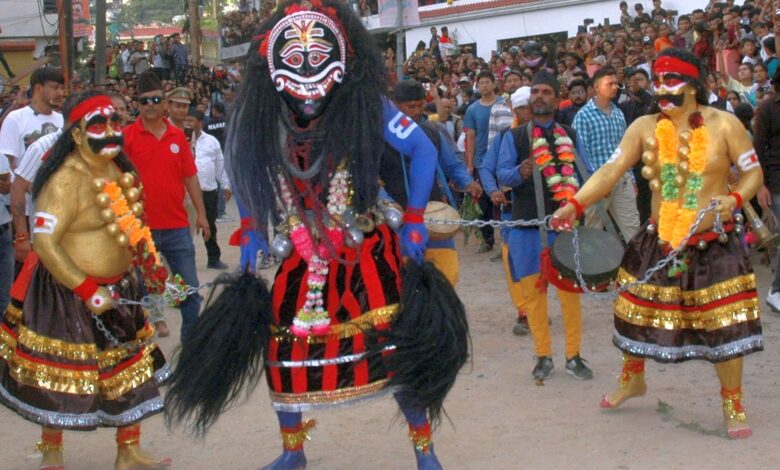
‘Hill Jatra’, the mask festival held in Soor valley of Pithoragarh
B.D.Kasniyal
Pithoragarh, Aug 24
‘Hill Jatra’, the traditional mask festival of Soor Valley of Pithoragarh, concluded at Kumaur village on Sunday, drawing thousands of spectators and eminent guests. The festival, which is believed to have been celebrated in the village for nearly 500 years, is held as part of the ‘Aathon’ festival dedicated to Goddess ‘Gaura’ and Lord ‘Maheshwar’.
The highlight of ‘Hill Jatra’ is the ceremonial awakening of ‘Lakhiya Bhoot’, a masked figure revered locally as ‘Virbhadra’, the fierce manifestation and devotee of ‘Lord Shiva’. According to Hindu mythology, ‘Virbhadra’ was created by Shiva after Sati, Shiva’s consort and one of the daughters of Daksha Prajapati, immolated herself following the humiliation of her husband at the yajna organised by her father at Kankhal near Haridwar.
“Virbhadra, the principal warrior of Lord Shiva, destroyed Daksha’s yajna and severed Daksha Prajapati’s head, despite the presence of several gods who supported Daksha,” said P.D. Pant, a cultural historian of the eastern Kumaon region.
‘Hill Jatra’ is essentially an agrarian festival of Soor Valley, depicting the traditional cycle of paddy cultivation and various aspects of rural life associated with farming in the region in earlier times.
“Hill Jatra is an agrarian festival of Soor Valley. It revolves around the traditional practice of paddy cultivation, and the various activities and situations associated with farming in ancient times are enacted in the village streets during the festival,” said Yashwant Singh Mahar, an organiser of the festival in Kumaur.
According to local sources, ‘Hill Jatra’ is also celebrated in villages including Dungari, Rawalgaon, Bajeti, Satgarh and Majirkanda, besides several other villages, as part of the ‘Aathon’ celebrations. However, the ritual awakening of ‘Lakhiya Bhoot’, regarded as a fearsome yet benevolent deity and a devotee of Lord Shiva, is performed only at Kumaur.
“We venerate ‘Lakhiya’ as the protector of the village and its crops. Great care is taken to maintain the purity of the rituals associated with awakening and worshipping him, while the masked figure is presented in the traditional form described in our Puranic imagination,” Mahar said.
During the festival, masked performers enact a series of characters and scenes associated with traditional agricultural life. These include a village sanitation worker, women transplanting paddy seedlings, an elderly woman arriving to witness the plantation, three pairs of bullocks ploughing the fields, a lazy bullock, and herds of deer and spotted deer that were once frequently seen around paddy fields. An old man smoking a hookah is another popular character portrayed during the festival.
“Through this festival, which has been depicted in the village for nearly 500 years, we try to preserve and portray the agricultural practices and rural life that prevailed in the Soor Valley in earlier times,” Mahar said.
The tradition is also believed to have a historical connection with the masked street festivals of the Kathmandu Valley in Nepal, particularly ‘Indra Jatra’. Villagers claim that the tradition was introduced in the region after their ancestors impressed a king of Kathmandu with their bravery and wisdom, and that the king gifted the festival tradition to them.
The combination of mythology, masked performances, agrarian rituals and local historical traditions has made ‘Hill Jatra’ one of the distinctive cultural festivals of the Soor Valley.