Dying hopes amid crumbling roads in Uttarakhand hills
Dying hopes amid crumbling roads in Uttarakhand hills
Prem Prakash Upadhyay ‘Natural’.
Bageshwar, Oct 19
In twenty-first-century India, as rhetoric around the “digital revolution” and “world-class infrastructure” reverberates across every platform, the remote mountain hamlets of Uttarakhand tell a far starker, tragic truth. Hundreds of villages across the state have been hollowed out into eerie “ghost villages.” While the search for livelihood and quality schooling drives this mass exodus, the deepest wound remains the acute absence of basic necessities chief among them, a dependable road.
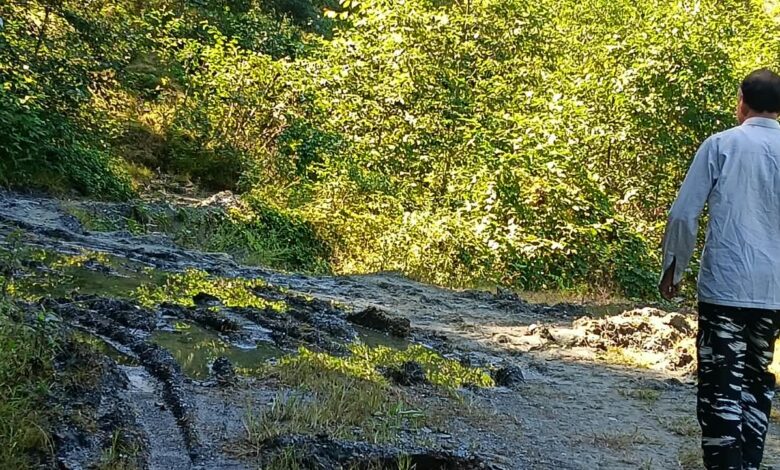
The Shuklayadi–Kheti–Dhari link road in Berinag tehsil of Pithoragarh district stands as a glaring monument to administrative neglect and political apathy. Five years ago, excavation and cutting work commenced, igniting a glimmer of hope. Villagers surrendered their fertile agricultural holdings in good faith, trusting that their sacrifice would pave a smoother path for generations to come. Yet half a decade on, the road remains unpaved and abandoned. Where lush fields once thrived, there is now an obstacle course of treacherous potholes, muddy swamps, monsoon gullies, and landslide debris.
Over 10,000 people have been suffering for the past five years, even after knocking on every official door. The villagers believe that responsible public representatives,media , and the government will listen to this problem. But no further step for road improvement has been taken yet.
Intended as a lifeline for a population of over ten thousand, this corridor has instead become a symbol of systemic failure. During the monsoon, it turns into a lethal trap. The most harrowing toll is paid during medical emergencies: whether it is a critically ill elder, an accident victim, or a woman in labour, villagers are forced to hoist patients on makeshift palanquins or shoulders to trudge miles on foot. All too often, precious lives are lost enroute simply because timely medical aid is out of reach. Are the citizens of independent India condemned to perish prematurely merely because they chose to live in the mountains?
The depth of despair is palpable in village squares, where conversations no longer center on progress, but on quiet resignation. Village elders often lament, “It seems this road will not be built in our lifetime.” From the doorsteps of the local administration to the offices of elected representatives, countless memorandums have been submitted, yielding absolutely nothing.
To political leaders and policymakers, the lives of hill communities appear to matter only during election season. Polls bring a flurry of grand announcements and hollow promises, only for the electorate to be cast aside the moment the ballots are counted. But the authorities must recognize that patience has its breaking point. Spirited youth and alert citizens are now uniting. This simmering frustration against chronic neglect and betrayal is poised to express itself at the ballot box.
The administration must realize that policies to stem rural migration cannot exist merely on paper; they must be delivered on the ground. Failing to expedite and macadamize the ShuklayadiKheti–Dhari road will not just leave a stretch of dirt unfinished—it will extinguish the common citizen’s faith in the democratic process. The mountains no longer seek empty promises, they demand asphalt, connectivity, and accountability.