83 year-old Munni Devi fights wild animals alone to save her fields and animals in Dehradun village
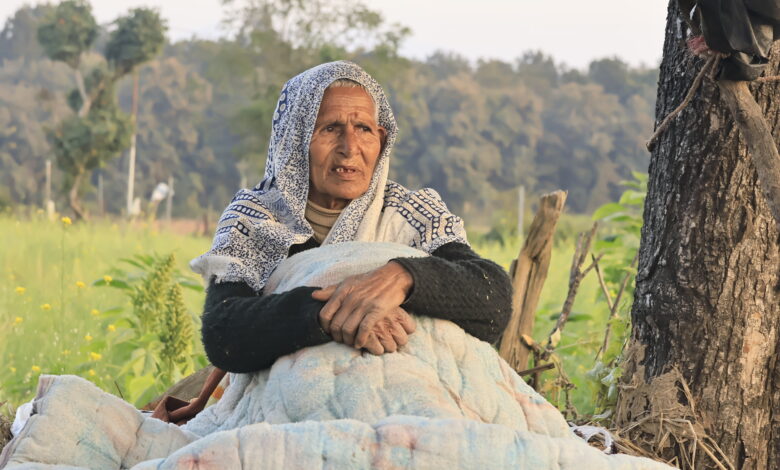
83 year-old Munni Devi fights wild animals alone to save her fields and animals in Dehradun village
Rajesh Pandey
Dehradun, Dec 1
Any discussion about abandoned farmlands in Uttarakhand’s hilly villages invariably revolves around two issues namely migration and wild animal attacks. However, the struggle of 83 year old lone woman farmer, right near the state capital, Dehradun, to keep her farm lands and animals safe is a story of courage and commitment amidst growing man-animal conflict in the state.
Munni Devi (83), a resident of Jheelwala, is an ordinary farmer but with extra ordinary grit and determination in fighting tirelessly to protect her farm and her approximately 40 livestock.
A Night Watchman on the Machan
Munni Devi, who depends on farming and animal husbandry is not well-off but explains that the farm produce is just enough for sustenance. “To save the wheat and mustard crops from animals, I stay on a machan (elevated wooden platform) built amidst my fields, even during the cold winter nights and patrol the fields with a torch throughout the night to secure my crops,” she said proudly.
“Hordes of animals come from the nearby jungle all night. Once, an elephant reached right into my courtyard,” she recounts.
“Recently, I harvested the paddy, but got almost nothing. The entire field was already destroyed by animals. The Forest Department gives compensation and considers their duty done, but what are we supposed to do? How do we escape these wild animals?” she asked.
She further explained that herds of leopards (baghera), wild boars, nilgai, and deer attack the fields. When she shines the torch light on them, they perceive a human presence and flee. However, the attacks are a daily affair. “Much land around us has been sold off; few fields remain here. That’s why the wild animals primarily target my field,” she observed.
“These Animals are Like My Children”
On reaching Munni Devi’ village, she was grazing her cattle in a nearby ground. Her daughter, Babli, also assists her with the farming and husbandry.
She possesses around 40 animals, including cows, calves, oxen, and two buffaloes, though only a few cows give milk. She has named all her cattle—Patanga, Itwari, Bannu, Titli, Kanchan, Nandi, Chaita, etc.
“These are all my children,” she says affectionately. “I have never abandoned my animals on the road. They graze here all day. I have planted fodder in the field for them, and we purchase animal feed from the market.”
Dedicated Life: No Time for Sleep
“I wake up around four in the morning. Actually, I barely sleep at all,” Munni Devi reveals. Pointing towards the machan in the field, she adds: “I stay there all night. I have put a mattress and a quilt there; there are no major issues. I must save the crop. This much hard work and struggle is necessary. My life has been dedicated to farming and animals,” she said.
Munni Devi recalled that she was born before Independence and moved to Jheelwala years ago. Leading us to the machan, which has a mattress, straw mat, and a quilt, she admits she plans to raise it higher so she can see the fields better. When asked if she doesn’t feel cold, she replies, “No, this quilt is enough. I am used to staying here. I try to save the crop; what can I do if the animals enter the fields? The torchlight usually keeps them away,” she explained.
The History of Jheelwala
The elderly farmer shares an interesting historical fact: She notes that there used to be many small and large lakes around Jheelwala. More significantly, the area was known for producing Urad dal (Black Gram). So much Urad, and a type of pulse called Jhilanga (a variety of Navrangi lentils), grew in Dandi, Ranipokhri, and Jheelwala that traders from Dehradun used to come straight to the fields. She believes that the area was initially called ‘Jhilangawala’, which later became ‘Jheelwala’. No lakes are visible here currently.
Solar Fencing Failed
Mohit Uniyal, a social activist and district president of Purv Congress also met with Munni Devi to inquire about the challenges she faced. “There should be a solid system to protect the fields from animal attacks,” she emphasized. She invested money in solar fencing, but it is now defunct. “The fencing is broken. Animals are causing huge losses to the crops. They even attacked my cows sometimes. One cow was found dead near the jungle.”
Munni Devi also recalled her personal tragedies. “Life has been full of struggle. When my husband passed away, I had four daughters and a nine-year-old son. My eldest daughter was in the 12th grade. I had a debt of ₹22,000. I ploughed the fields myself and raised the children through animal husbandry. I repaid the debt and married off my daughters,” she said.
“In 2002, another major tragedy occurred. My 24-year-old son died in a road accident, and I was left alone. I was in shock for three years after my son’s death. Slowly, I gathered the courage and found a reason to live through the animals and this farming. A quarter of a century ago, I had only two cows; today, I have 40 animals. They are all the descendants of those two cows,” Munni Devi states proudly.
“Whatever I am today is because of this land and my cows. I am self-reliant; I never had to beg anyone. This land and these cows never allowed me to face financial difficulties,” she concluded while tending to her cows.