
LPG cylinder shortage hits both industry and domestic households
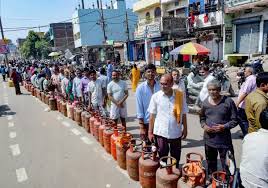
LPG cylinder shortage hits both industry and domestic households
By Shubh Arora
The war in Iran and the Middle East highlights Indias’ vulnerability as the worlds’ second-largest importer of LPG, after China. India imports about 60% of its LPG, 90% of which is routed through the Strait of Hormuz. The Iranian government has permitted two Indian LPG tankers to go through since the strait closed. Another three have been given permission but this is only a fraction of our daily demand.
The government is giving priority to its 333 million active domestic LPG users from which ten crore connections have been provided under the Pradhan Mantri Ujjwala Yojana scheme aimed at providing clean cooking fuel to rural households. But by doing so, industry has been immediately hit. Before the Middle East crisis, roughly 40% of Indias’ total LPG consumption was for non-domestic use.
Industries are now having to shut or else stagger operations till such as the war comes to an end. Already, more than four hundred ceramic units in Gujarat’s Morbi have halted operations. Nearly 450 of the town’s 670 ceramic units have shut and about 430 factories have decided to suspend operations for at least three weeks.
The South Gujarat Textile Processors Association declared that around 200 out of the 400 textile factories in the western city of Surat have halted operations. The rest have cut their weekly days of operation from seven to five. It said half a million day laborers have lost their jobs due to this LPG shortage and have left the city.
“Even if this conflict stops tomorrow, it will take around six to 12 months to get back to normal,” said Jitendra Vakharia, president of the association. “In the future, there will still be a shortage of raw materials and textiles. Owners will have to accept it,” Vakharia added, `A fibre factory in the city uses 13.2 tons of LPG per month to operate machinery. The shortage has forced it to close for one month and to cut the jobs of more than half of its day laborers. The owner said he hopes the government steps in to support the industry, or finds an alternative fuel that lets them keep their businesses running.’
LPG shortage has adversely affected sectors including foundries, aluminum units, fabrication, and pump manufacturing. In the industrial town of Coimbatore, MSMES are grappling with the double whammy. LPG shortage and 25 per cent rise in steel prices and a 20 per cent surge in aluminium and copper prices. Around 30% of the 2.5 lakh MSMEs units in Coimbatore have been forced to stop or limit production. Industry experts warned that up to 4 lakh jobs out of a 12-lakh workforce could be impacted if the situation persists.
The Coimbatore District Small Industries Association has requested the central government for assistance, including the rationing of LPG to sustain operations. Tamil Nadu state government has held meetings to address the issue and has proposed incentives for using alternative energy sources, such as induction stoves. To make the situation worse, several MSMEs are experiencing a cash crunch, with bankers and financiers refusing to extend credit to these affected industries.
In West Bengal, the Darjeeling Tea Association warned that tea estate factories in Darjeeling are facing a severe LPG shortage that could halt operations at tea gardens employing 55,000 workers. In the early days of the LPG crisis, hotel associations had already flagged that almost a third of hotels and restaurants were downing their shutters, owing to a near complete halt in the LPG supply from distributors. In Uttar Pradesh, FIRs were registered against 12 LPG distributors, while 74 others were booked for alleged malpractices of selling cylinders in the black market.
The problem is the shortage of domestic cylinders has also grown more intense especially for the lower middle class, many of whom are being forced to buy cylinders in the black market at astronomical prices that can go up to Rs 5000. Often, even those willing to pay extra are not being able to access cylinders. When a delivery agent was asked if he could somehow arrange a cylinder unofficially, the Indane delivery agent said the war had made things far stricter. ”There is documentation at every step now. Every cylinder is being accounted for. If even one cylinder is diverted, we could get caught. There is no chance of doing anything at our level, maybe someone higher up can help,’ he said.
Several households are now using cow-dung cakes and firewood to cook in their homes. While this can work in villages, in cities, most people living in rented accommodation will not be permitted to use coal or firewood inside their homes.
The government is facing a tough balancing act. The government push to iron out domestic supply backfired in many ways. For one, the move choked the production of a key solvent—isopropyl alcohol or IPA—used in essential medicines and lifesaving drugs, and forced top drugmakers to warn of disruptions to medicine supplies.
Realising the seriousness of the situation, the government resorted to emergency measures ordering the immediate reallocation of a ‘certain minimum’ quantum of critical refinery inputs such as propylene and propane to the countrys’ top IPA supplier Deepak Fertilisers and Petrochemicals Corp. Ltd (DFPCL) and others for priority sectors including pharmaceuticals, food and distribution and petrochemicals.
The supplies for these sectors would be based on allocations for high technology under the petroleum ministry, even as the priority on supply of these molecules for LPG production continues. Sources in the ministry of petroleum pointed out that the centre is taking strict measures to ensure that petrochemical and crude oil derivatives used to make essential medicines from ethanol, acetone, aniline and para-amninophenol which are critical for the pharma industry must continue to be provided to the pharma industry.
This is not to say our neighbouring countries such as Pakistan, Bangladesh, Nepal and Sri Lanka, where LPG is central to everyday cooking, have not been hit. Slowing imports have strained distribution systems, prompting governments to prioritise household supply and restrict commercial use across all these countries also.
Energy experts point out that energy companies had warned successive government about the strait of Hormuz becoming a chokepoint which could block our supply of petroleum and LPG. They had also warned that India needed to maintain 40 to 60 days of reserve cover for critical fuels. By contrast India, has just over 20 days of LPG storage and even less of petrol.
It is imperative to build buffers or diversify supply in order to absorb future shocks. With supplies from other countries – such as from the US – taking weeks to arrive and at significantly higher cost, the Indian government has directed refineries to maximise LPG production for household use and supplies have been prioritised for hospitals and educational institutions. Businesses are, however, affected and this has hit the MSMEs hard.