
Who Will Be the Chief Minister? Who Will Rule Tamil Nadu?
Who Will Be the Chief Minister? Who Will Rule Tamil Nadu?
Advocate Kayal M.N. Ahmed Sahib
Chennai, April 10
In a dense forest, many animals lived together. Among them was a spotted deer, a symbol of peace, honesty, and trust. There was also a wolf, representing cunning, lust for power, and betrayal of promises. One day, the wolf got trapped in an iron snare and howled in pain. The deer, passing by, thought: He may be wicked, but he is now helpless. Helping him is an act of humanity.
“I will save you, but you must never harm others again,” said the deer, setting a condition. The wolf immediately replied, “Certainly! I have changed. From now on, I will live for others.” Believing this, the deer broke the iron trap with its antlers. In the process, its antler broke, blood gushed out, and the deer collapsed unconscious.
Freed from the trap, the wolf instantly returned to its true nature. It howled and summoned its pack. Soon, several wolves surrounded the injured deer. “I trusted you… I helped you for the sake of others… Why are you doing this?” asked the deer in shock.
The wolf laughed and replied, “Power knows no gratitude. We have not changed—you misunderstood us.” Then, the pack of wolves tore apart the fallen deer. This is what is called cunning deceit. What we witness around us in the political arena is no different from such tactics.
Political Intrigue :
Political intrigue refers to deliberate, covert, and strategic actions undertaken to gain or retain political power. These are not visible to the public eye but occur behind the scenes. They include secret alliances, hidden agreements, misinformation campaigns, and long-term strategic planning. Such calculated, concealed manoeuvres are often employed by individuals seeking dominance in power struggles.
These intrigues may aim to weaken someone or remove them from power. Internal party conflicts, temporary alliances, and eventual betrayals are all part of this process. Though alliances may appear united outwardly, internal divisions and power struggles are deeply embedded within them. Only those who navigate these complexities can survive in politics.
Reactive Abuse as a Political Strategy :
Another subtle tactic used in politics is reactive abuse. A political leader or party is continuously provoked through criticism and defamation, pushing them toward anger. Once they respond strongly, they are portrayed as aggressive or undemocratic. Public attention is thus diverted from real issues to the individual’s behavior.
One may observe this pattern in the continuous attacks made by Edappadi K. Palaniswami against former Chief Minister M. Karunanidhi. The counter-criticisms that follow only reinforce this cycle. Such incidents have become all too familiar during election periods, representing a degraded form of political discourse.
Role of the Election Commission :
In the face of such democratic violations, the Election Commission is expected to act as a regulator. But what happens when the Commission itself violates rules?
During the West Bengal elections, reports suggest that nearly 9.1 million voters were removed through voter list revisions, disproportionately affecting minority communities, particularly Muslims. Even candidates contesting elections reportedly had their names removed. In constituencies like Nandigram, the large-scale removal of Muslim voters has raised serious concerns.
This act, which undermines the fundamental democratic right to vote, demands judicial scrutiny. The Supreme Court must intervene once again, and all eligible voters must be reinstated. Democratic forces must unite to condemn such actions.
Developments in Tamil Nadu :
At a time when these concerns are being raised, the Election Commission has abruptly transferred the Chief Secretary of Tamil Nadu. M. K. Stalin has strongly condemned this move, stating that the Commission appears to be acting under the influence of the Bharatiya Janata Party leadership. He has also warned that such actions are part of a long-term authoritarian agenda extending beyond the 2026 elections.
Interestingly, similar actions were not taken in BJP-ruled states like Assam or in Bihar during elections. This selective intervention has drawn sharp criticism.
Silence and Selective Responses :
It is noteworthy that, apart from leaders like Thol. Thirumavalavan and other secular alliance members, few have condemned this issue. Actor-turned-politician Vijay has remained silent even on this matter.
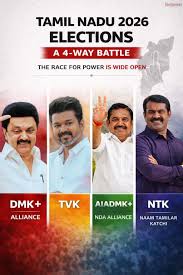
Vijay’s political entry is not merely that of an actor; it represents the emergence of a new vote bank in Tamil Nadu. This could significantly influence the 2026 elections. Traditional parties like DMK and AIADMK may face fragmentation of their voter bases. The outcomes of the 2026 elections will shape the political trajectory leading into the 2029 parliamentary and 2031 assembly elections.
However, it is concerning that candidates with criminal backgrounds are reportedly included among Vijay’s party nominees. While his supporters claim that youth are becoming politically engaged, true political awareness requires deeper ideological grounding. Questions remain: Who is guiding Vijay? Will his entry benefit Tamil Nadu or harm it? The answers will emerge after the elections.
Seeman’s Distinct Approach :
Despite ideological differences, Seeman has adopted a unique campaign stance—urging those who accept money for votes, consume alcohol irresponsibly, or support corruption not to vote for him. Such a position stands out in today’s political climate. But, By fielding Brahmin stronghold-like candidates within the Dravidian fortress, he has, in terms of ideological loyalty, even outpaced the Bharatiya Janata Party—and that would not be an exaggeration
Sunk Cost Fallacy in Politics :
A persistent psychological bias in Indian politics is the sunk cost fallacy. Voters continue to support a party or leader simply because they have done so for years, even if current performance is unsatisfactory. Similarly, political parties cling to failed policies instead of adapting to changing realities. Sound political decision-making requires focusing on present conditions and future outcomes rather than past investments.
Candidate Selection and Caste Politics :
As the 2026 Tamil Nadu Assembly elections approach, political activity has intensified. Candidate lists reveal that selections are often influenced not just by merit or public service but by regional influence and caste-based vote banks.
For instance, iIn the Kongu region, priority is given to the Gounder community.In North Tamil Nadu, candidates are chosen to appeal to the Vanniyar community. In South Tamil Nadu, Mukulathor and Nadar vote bases are carefully considered. This reflects the continued dominance of identity politics. Despite public rhetoric about social justice and caste eradication, electoral practices tell a different story. True democratic success lies in voters choosing candidates based on integrity and capability, beyond caste considerations.
Thirumavalavan’s Political Vision :
The political campaigns of Thol. Thirumavalavan emphasize caste abolition as the path to people’s liberation. He consistently raises his voice against caste oppression and works to mobilize youth toward socially conscious politics.
His efforts focus on education, social rights, and security for marginalized communities, while also promoting Tamil identity, language, and culture. He actively spreads awareness against authoritarian politics.
Under his leadership, the Viduthalai Chiruthaigal Katchi has evolved into a movement upholding secularism and democratic values. There is growing expectation in Tamil Nadu’s political sphere that he should emerge as a Chief Ministerial candidate by 2031. When you reflect on the story of the deer and the wolf at the beginning of this article, questions may arise: Who is the wolf? Who is the deer? What does the iron trap represent?
I leave those answers to you. The results of the 2026 elections, and the five years that follow, will provide clarity. The leader who aspires to become Chief Minister in 2031 must overcome many such traps and conspiracies. Until then, let us wait.
( Advocate Kayal M.N. Ahmed Sahib is a journalist and lawyer. The views are personal.)