
Ban on entry of non-Hindus at Hindu temples in offing as assembly polls approach, APCR fact finding report highlights targeting of Muslims
Ban on entry of non-Hindus at Hindu temples in offing as assembly polls approach, APCR fact finding report highlights targeting of Muslims
S.M.A. KAZMI
Dehradun, Jan 27
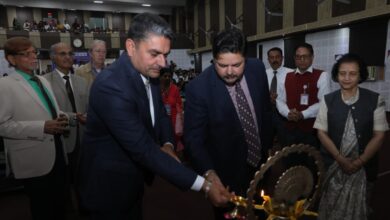
With Uttarakhand state assembly elections less than a year away, the ruling Bharatiya Janata Party (BJP)/ RSS dispensation have scaled up their efforts for communal polarisation and consolidation of majority Hindu votes. In this direction, a move is afoot to ban the entry of non-Hindus at the Hindu religious places particularly ‘Char Dham” temples of Badrinath, Kedarnath, Gangotri and Yamunotri. With an aim to gauge the public reaction, the President of the Badrinath-Kedarnath Temple Committee (BKTC) Hemant Diwedi has announced that a decision to this effect on the demand of the various stake holders including ‘Pandits and Purohits’ would be taken at the next meting of BKTC scheduled to held in the month of February, 2026. The move is seen as an effort to consolidate the Hindu votes ahead of the crucial state assembly polls scheduled in early 2027.
Few days ago, similar move was initiated at Haridwar where a fresh board was put up announcing the ban on the entry of non-Hindus at Har ki Pauri, Interestingly, the ban part of the local municipal act has been in vogue since 1916 but has been again announced with much fanfare as if something new has happened.
The ban on non- Hindus is basically aimed at Muslims. Although no Muslims visit these revered places of Hindus as pilgrims but few of them are involved in other trades related with ‘Char Dham’ annual pilgrimage. There are few pony owners from neighbouring Uttar Pradesh who go up to Kedarnath ferrying pilgrims and few taxi drivers who take Hindu pilgrims to these places. Few Muslims also own some shops enroute small towns of Garhwal.
But it would be interesting to watch that how such a ban would effect the pilgrimage of some Sikhs, Buddhists and Christian foreigners to these shrines. However, Sangh Parivar believe that Sikhs, Jains and Buddhist are part of large Hinduism umbrella.
The move to ban entry of non-Hindus at Hindu religious places in Uttarakhand considered as ‘Dev Bhoomi” has come at a time when two reports have indicted the state BJP government being part of the massive campaign against the minority Muslim community in the state.
In it’s latest, “ Report 2025: Hate Speech Events in India” of the Centre for the Study of Organised Hate (CSOH) , Washinton DC in the second week of January 2026, Uttarakhand Chief Minister Pushkar Singh Dhami has emerged as the most prolific hate-speech actor in 2025, with 71 speeches, followed by Antarrashtriya Hindu Parishad chief Pravin Togadia (46) and BJP leader Ashwini Upadhyay (35).
India Hate Lab (IHL) of the CSOH documented 1,318 hate speech events targeting religious minorities, particularly Muslims and Christians, in 2025 across 21 states, one union territory, and the National Capital Territory (NCT) of Delhi. On average, four hate speech events occurred per day. This marks a 13% increase from 2024, and 97% increase from 2023, when 668 such incidents were recorded.
On January 21, Association of Protection of Civil Rights (APCR) in its’ latest fact finding report Titled “Excluded, Targeted and Displaced- Uttarakhand and The politics of hate”’ released on January 21,2026 at Press Club of India, summarised that the right-wing Hindutva groups have fueled communal tensions in Uttarakhand through a surge in hate crimes, violence, and economic boycotts targeting Muslims, creating an atmosphere of fear and intimidation since 2021.
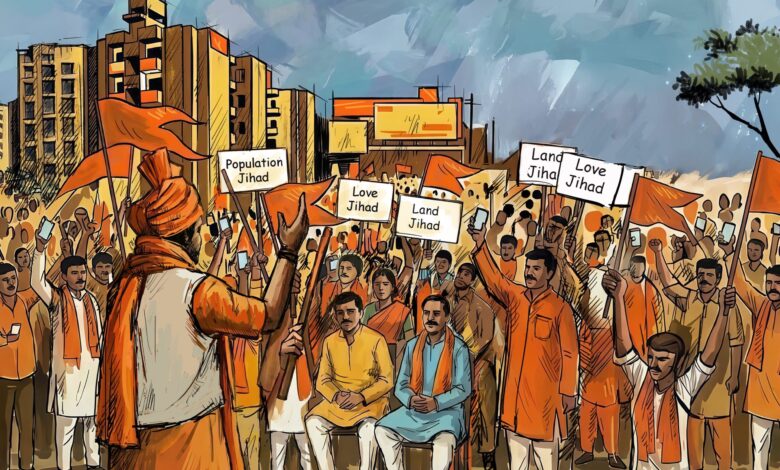
This pattern, often away from media glare, intensified after the 2023 Purola incident—where false “love jihad” kidnapping allegations led to Muslim families fleeing or selling properties—and has spread to districts like Uttarkashi, Tehri, Chamoli, and Gairsain. Recent cases include mosque-targeted tensions in Uttarkashi, evictions of Muslim shopkeepers in Tehri’s Kirti Nagar and Chauras over “love jihad” claims, vandalism and looting of 15 shops in Nanda Ghat after an eve-teasing allegation, 10 evictions in Gauchar over a parking brawl, and a Gairsain trade body’s 2024 ultimatum for Muslims to leave by December 31. In Chamoli, 500 unidentified persons face police cases amid ransacked Muslim shops. Many affected Muslims, originating from Najibabad city of Uttar Pradesh since the 1970s-80s, are now branded “outsiders” despite migrating in pre-2000, when Uttarkhand had not been carved out of Uttar Pradesh yet.
Key flashpoints trace back to the December 2021 Haridwar Dharm Sansad, where leaders like Yati Narasinghanand, Prabodhanand Giri, Yatindranand Giri, Sadhvi Annapurna, Swami Anand Swaroop, and Kalicharan Maharaj incited violence against Muslims, calling for a Hindutva rashtra and killings. The BJP-led government under Chief Minister Pushkar Singh Dhami has amplified this through anti-”land jihad” and “mazar jihad” drives—recovering 5,000 acres by May 2024— hate speech conspiracies like “Thook Jihad,” economic boycott calls, and “non-Hindu” entry bans in Garhwal hills. Purola’s aftermath saw Dhami push background checks to curb “love jihad,” while a 2023 Hindutva Maha Panchayat escalated tensions, prompting Uttarakhand High Court intervention for peace, the report mentions. Legislatively, the 2024 Uniform Civil Code (UCC) Act overrides minority personal laws on marriage, divorce, inheritance, and adoption, raising fears of cultural erosion among Muslims and Christians. 2025 amendments in Uttarkhand include the UCC (Amendment) Bill comprise harsher penalties for unregistered live-in relationships, up to 7 years imprisonment, and powers to cancel registrations, the Freedom of Religion and Prohibition of Unlawful Conversion (Amendment) Bill has life terms for “forced conversions,” broader “allurement” definitions, penalties for false marriage promises or religious propaganda, and Minority Educational Institutions Bill which extends minority status to Sikhs/Jains/Christians/Parsis/Buddhists while mandating madrasa affiliation with the state board or closure. These target interfaith ties and madrasas, framed as anti-”love jihad.” Recent controversies, like the demolition of a centuries-old mazar at Doon School by Hindutvalinked groups amid the “Mazar Jihad” campaign, underscore ongoing threats. Dhami’s focus on divisive rhetoric has eroded Uttarakhand’s social fabric, demanding urgent intervention to protect vulnerable Muslim communities.
Every other day there are incidents where Hindu right Wing groups targets Muslims on one pretext or other in the entire state particularly in the capital city of Dehradun. Three days ago taking cue from the state BJP government campaign against ‘Mazars’, a group of Hindu Rakshak dal members vandalised an old ‘Mazar’ in Mussoorie. In another incident, a Muslim tailor was targeted for naming his shop as ‘Pundir Tailor’. All his pleadings that he was a Muslim Rajput with ‘Pundir Gotra’ fell on deaf ears as he was taken to police station. Finally many of his neighbours came to his rescue. Such communal and divisive actions are expected to escalate as the assembly polls draw nearer.