Are Gen Z Youth Ready to Defend Democracy?
Controlled Opposition and B-Team Politics.
Are Gen Z Youth Ready to Defend Democracy?
Controlled Opposition and B-Team Politics.
Advocate Ahamed Sahib
Chennai, June 8
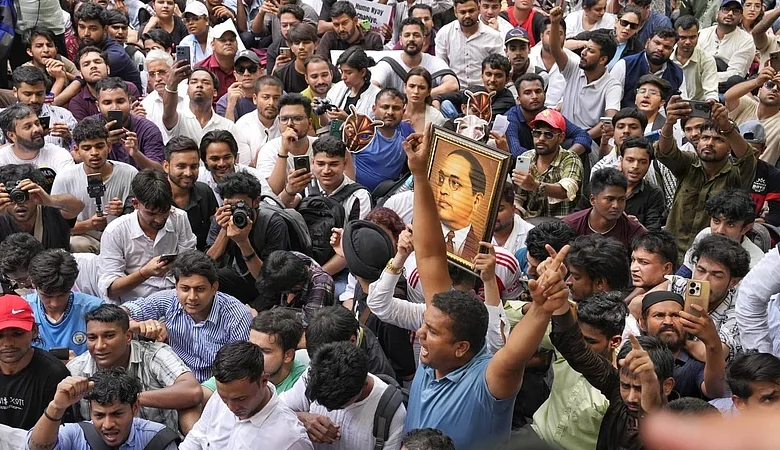
The protest organized by the Cockroach Janta Party (CJP) at Jantar Mantar in New Delhi has emerged as one of the most widely discussed youth movements in recent years. What began as a satirical social media initiative evolved into a nationwide campaign led by India’s Gen Z generation against examination irregularities, question-paper leaks, and failures in educational administration. The movement transformed concerns about students’ educational rights and future prospects into a subject of national debate.
The protesters demanded the resignation of Union Education Minister Dharmendra Pradhan, holding him accountable for alleged irregularities and paper leaks in examinations such as NEET-UG, CUET, CBSE, and SSC. They also called for an independent inquiry into the functioning of the National Testing Agency (NTA) and demanded structural reforms to restore public confidence in India’s examination system.
The movement’s founder, Abhijeet Dipke, returned from the United States to personally lead the protests. His decision to carry a portrait of Dr. B.R. Ambedkar attracted considerable attention. Organizers encouraged participants to carry the national flag and books, symbolizing their commitment to citizenship, education, and democratic engagement. The protest received support from social activist Sonam Wangchuk, actor Prakash Raj, student organizations, education-rights activists, social media influencers, and numerous young people concerned about their future.
Interestingly, while student protests at institutions such as Jawaharlal Nehru University (JNU) against government education policies, fee hikes, or perceived attacks on democratic rights have often faced opposition from the ABVP, police intervention, legal action, and administrative restrictions, the CJP protest concluded relatively peacefully without experiencing comparable levels of suppression. This contrast raises important political questions.
A similar phenomenon was witnessed during the anti-corruption movement led by Anna Hazare in 2011. That movement generated a powerful anti-Congress sentiment and significantly influenced the political climate that contributed to the Congress Party’s defeat in the 2014 general elections. Anna Hazare was widely celebrated as the “conscience of the nation.” Yet, after the BJP came to power, his public visibility and political relevance appeared to diminish considerably.
This raises an important question: Will the Cockroach Janta Party evolve into a genuine political force capable of channeling youth dissatisfaction into organized politics, or is it merely another example of what political scientists describe as “Controlled Opposition” or “Manufactured Opposition”? Or will it disappear as a temporary phenomenon? Only time will provide the answer.
In political science, the concept of Controlled Opposition or Manufactured Opposition refers to a situation in which those in power weaken genuine opposition while promoting an alternative opposition that remains manageable and non-threatening. Such strategies redirect public anger and dissent into channels that do not endanger the ruling establishment.
One of the most frequently cited historical examples is Operation Trust, conducted in the Soviet Union between 1921 and 1926. The Soviet secret police, the OGPU, established a fake anti-communist organization that appeared to oppose the government. In reality, the organization functioned as a trap designed to identify, monitor, and neutralize genuine opponents of the Soviet regime.
Prominent anti-Soviet figures such as Boris Savinkov and Sidney Reilly were deceived by this operation. Through this strategy, the Soviet government obtained valuable information about opposition networks, funding sources, and international connections. The operation successfully weakened authentic opposition while promoting a controlled alternative. Detailed discussions of these events can be found in John Costello and Oleg Tsarev’s The Trust and Christopher Andrew and Oleg Gordievsky’s Spymaster.
The suppression of dissent under Joseph Stalin provides another historical example. Numerous political rivals, military officials, and intellectuals were accused of participating in “counter-revolutionary conspiracies,” “foreign espionage,” or plots to overthrow the government. These events are extensively documented in works such as The Great Terror and various biographies of Stalin.
Similarly, the FBI’s COINTELPRO program in the United States infiltrated political and social movements, creating internal divisions and confusion. These operations are examined in books such as The COINTELPRO Papers and Enemies.
Modern Russia has generated similar debates through Vladimir Putin’s concept of “Managed Democracy.” Under this model, opposition parties may exist, but only within limits that do not pose a serious challenge to the ruling establishment. Scholars have discussed this phenomenon in books such as Nothing Is True and Everything Is Possible and The Future Is History.
India has never openly witnessed an operation identical to Operation Trust. Nevertheless, during the Emergency (1975–1977) imposed under Prime Minister Indira Gandhi, opposition leaders were arrested and media freedoms were restricted.
If one asks whether only the BJP under Prime Minister Narendra Modi has benefited from such political dynamics since 2014, the answer is more complex. Throughout Indian political history, the fragmentation of major parties, divisions within regional parties, and allegations of B-Team Politics have repeatedly surfaced.
Citizens must therefore critically examine whether political developments around them represent genuine democratic opposition, controlled opposition, manufactured opposition, managed democracy, or merely strategic political alliances. Such analysis is essential for maintaining the health of democracy.
Gen Z youth, in particular, must equip themselves with a deeper understanding of these political concepts. Political disagreements are natural, but responsible criticism requires knowledge, patience, and democratic maturity. In an era shaped by sophisticated political strategies, emotional reactions alone are insufficient. What is needed is informed engagement, critical thinking, and a commitment to democratic values.
Political realities must be understood as they exist. Whether one agrees with a government or not, democratic forces must seek to influence public policy through constructive engagement, civic participation, and sustained advocacy. The strength of democracy lies not merely in opposing power, but in holding power accountable through informed and organized public action.
Instead of limiting political participation to social media trends and short-form entertainment, young people must immerse themselves in serious political education and public policy. They should advocate for improved drinking water projects, expanded desalination initiatives, stronger support for farmers, enhanced healthcare services, quality public education, social justice measures, women’s empowerment, employment generation, affordable housing, and the protection of democratic institutions.
If Gen Z youth mobilize around such constructive public issues, they can create a genuine democratic transformation. Public movements rooted in knowledge, social responsibility, and democratic values have the potential to reshape the future of the nation.
Debates surrounding the reliability of Electronic Voting Machines (EVMs) continue to emerge across the political spectrum. Questions relating to electoral transparency and public confidence in the electoral process deserve democratic discussion and scrutiny. Young citizens must engage with these issues through constitutional and democratic means.
When such movements emerge, they also expose participants to the realities of power structures and institutional pressures. Through direct engagement, young people gain a deeper understanding of democracy, governance, and political accountability.
The ultimate question remains: Are Gen Z youth prepared to shoulder the responsibility of safeguarding democracy? That is the million-dollar question.
(Advocate Ahamed Sahib is leader of VCK)