INDIVIDUAL SINCERITY, FIRM COMMITMENT NEEDED TO CHALLENGE BJP-RSS NARRATIVE: CONGRESS LEADER SURYAKANT DHASMANA
INDIVIDUAL SINCERITY, FIRM COMMITMENT NEEDED TO CHALLENGE BJP-RSS NARRATIVE: CONGRESS LEADER SURYAKANT DHASMANA
Dehradun, June 6
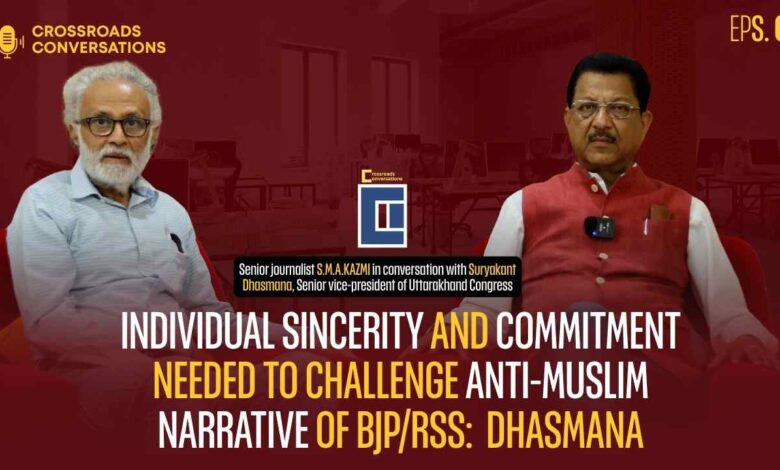
In a candid and wide-ranging interview on The Crossroads Conversations podcast hosted by The Northern Gazette, senior Congress leader and Uttarakhand Pradesh Congress Vice President, Suryakant Dhasmana, made an impassioned plea to political workers and citizens. He asserted that a deeply rooted sense of individual sincerity and an unyielding commitment to secularism are the only tools capable of breaking the dominant political narratives set by the BJP and the RSS.
Link to Podcast: https://youtu.be/VKqcgxUvlaQ
Reflecting on a tumultuous four-decade-long political career, Dhasmana discussed his accidental entry into politics, the scars of the Uttarakhand statehood movement, internal party factions, and the blueprint for the upcoming 2027 state assembly elections.
An Accidental Political Journey
Describing his entry into the political arena, Dhasmana revealed that he never planned on becoming a politician.
“I entered politics entirely by accident during my days at DBS College in 1982 following a dress-code dispute with a teacher, and then out of sheer obligation, I could never leave,” he remarked.
His early rise through student union leadership eventually caught the attention of veteran statesman Hemvati Nandan Bahuguna, who became his political mentor. Dhasmana subsequently entered mainstream politics through the Lok Dal and later the Janata Dal, eventually rising to become a key national youth leader in the Samajwadi Party under Mulayam Singh Yadav during the early 1990s.
Addressing the ‘Villain’ Label and the 1994 Karanpur Shooting Case
Dhasmana directly addressed the historical “villain” label frequently thrown at him by political rivals regarding the peak years of the Uttarakhand statehood movement in 1994. At the time, as a top leader of the ruling Samajwadi Party in Uttar Pradesh, Dhasmana became a primary target for local public anger when statehood protests collided with intense anti-reservation agitations.
Recalling the tragic events of October 3, 1994, when a mob surrounded his residence in Karanpur, Dehradun, during a city-wide curfew, Dhasmana explained that his state-allotted Y+ security personnel opened fire to protect the premises, resulting in the tragic death of one youth and injuries to two others. Despite local political rivals orchestrating a cross-FIR to name him in the case, Dhasmana highlighted his ultimate vindication:
“I faced 506 court hearings over 18 long years in the Dehradun courts. In 2012, the special CBI court honorably acquitted me, questioning how a civilian could even order police personnel to fire. I lost 18 of my golden years to a politically motivated allegation, but I maintained total faith in the judiciary.”
He firmly rejected the notion that he was “anti-Uttarakhand,” pointing out that he served as the chairman of the Vinod Bharatwal Drafting Committee, which formulated the very first government-accepted blueprint for the creation of the hill state.
The Shift to Congress and Navigating Internal Factionalism
Dhasmana explained that his eventual departure from the Samajwadi Party around the year 2000 was entirely ideological. When the SP chose to formally oppose the Uttarakhand Statehood Bill in Parliament, Dhasmana chose his principles over party loyalty, subsequently joining the Indian National Congress.
When asked about the notorious internal sabotage and factionalism within the Uttarakhand Congress—particularly during his 2013 Dehradun mayoral race, where party insiders actively campaigned against him and ordered ward candidates to omit his photographs from campaign banners—Dhasmana acknowledged it as a flaw of “surplus democracy.”
“While the BJP suppresses internal power struggles through a top-down machinery, Congress suffers from an excess of internal democracy. We paid heavily for it in past elections. However, a good sense is prevailing now. Senior leaders like Harish Rawat, Ganesh Godiyal, Yashpal Arya, and Pritam Singh realize that if we do not put an end to factionalism, the future of Congress in Uttarakhand will be in jeopardy.”
Countering the “MMM” (Masjid, Mazar, Madarrasa) Narrative
Lashing out at the current state government’s governance model, Dhasmana accused the BJP of deliberately avoiding real issues like rampant unemployment, paper leaks, economic distress, and inflation.
“The BJP’s entire political strategy from morning to night revolves around a manufactured ‘MMM’ formula—Masjid, Mazar, and Madarsa. They hype routine administrative verification drives to target minorities because they have no real development or employment data to display.”
Dhasmana cited the recent “Mohammad Deepak” incident in Pauri Garhwal—where a young gym trainer risked his life to prevent communal violence—as a symbol of India’s true composite culture. While noting that national leader Rahul Gandhi promptly recognized the youth’s bravery, Dhasmana stated that he was the first senior state leader to contact the state’s top bureaucrats, including the Chief Secretary and DGP, to warn them against allowing disruptive forces to ruin communal harmony.
Environmental Crisis: The Forgotten Electoral Issue
As a Himalayan state grappling with soaring summer temperatures reaching the mid-40s, Dhasmana emphasized that ecological destruction has reached a tipping point. He condemned the unchecked mining and “looting” of riverbeds across the Ganga, Yamuna, and Sharda river systems. Dhasmana confirmed that environmental conservation will be positioned as a core electoral issue for the Congress party moving forward, noting that Rahul Gandhi is actively engaging with leading environmentalists to construct a sustainable policy framework for the state.
Looking Ahead to 2027
Concluding the interview, Dhasmana expressed absolute confidence that the Congress party would form the government in Uttarakhand in the 2027 assembly elections by relying entirely on direct public consensus rather than financial resources.
On his personal plans to contest, the 11-year veteran state vice president remained disciplined: “The Dehradun Cantonment area remains my core base, and I have worked tirelessly there despite electoral setbacks. Ultimately, the high command will decide my role. Whether I am asked to contest or to work behind the scenes to secure victories for others, my singular goal is to bring Congress back to power to save the soul of Uttarakhand.”