Himalayas needs wiser technology as revealed in ‘HIMALYA’ Blueprint
Himalayas needs wiser technology as revealed in ‘HIMALYA’ Blueprint
Dehradun, Sept 3
“The Himalayas don’t just need smarter technology. They need wiser technology,” this presentation’s central proposition states, capturing the larger ambition behind Uttarakhand’s proposed Eco-AI journey which was unveiled here today.
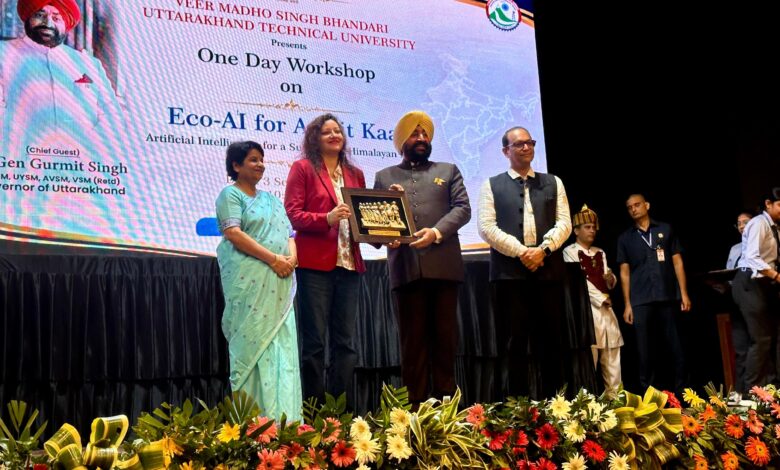
Uttarakhand is looking to position itself as a national laboratory for responsible artificial intelligence in difficult terrain, with a proposed HIMALYA framework aimed at using emerging technologies for disaster resilience, biodiversity conservation, public service delivery and livelihoods across the Himalayan state. The proposal was presented at Lok Bhavan, Dehradun, in the presence of Lt. Gen. (Retd.) Shri Gurmit Singh, Governor of Uttarakhand, along with eminent experts and institutional leaders including Dr. Shekhar C. Mande, Dr. Anil Prakash Joshi, Prof. (Dr.) Tripta Thakur and Dr. M. M. Tripathi.
Dr. Subi Chaturvedi, Global SVP and Chief Corporate Affairs & Public Policy Officer at InMobi, who formulated and presented the HIMALAYA Framework for Eco-AI, said Uttarakhand should pursue a distinct technology pathway rather than seek to replicate conventional AI infrastructure hubs. She argued that the state’s geography, ecological wealth, biodiversity, traditional knowledge and institutional ecosystem give it a unique opportunity to demonstrate how AI can be deployed for public good in challenging environments.
“Uttarakhand should not aspire to become another AI infrastructure hub. It has the opportunity to become India’s leading laboratory for responsible AI in difficult terrain, where technology is used not simply to optimise systems, but to protect lives, strengthen livelihoods, preserve fragile ecosystems and take public services to the last mile,” Chaturvedi said.
The proposed HIMALAYA Framework places AI within a broader development strategy for Uttarakhand, linking technology and innovation with climate resilience, ecological protection, healthcare, education, agriculture, tourism, road safety, women’s livelihoods and connectivity in remote and border communities. The framework is positioned as a possible model for how AI can support the vision of Viksit Bharat 2047 while responding to the specific vulnerabilities and opportunities of mountain regions.
A central proposition of the framework is that Uttarakhand’s AI journey should be measured not merely by models, datasets or technology infrastructure, but by tangible outcomes for people and the environment. These include lives protected from disasters, water sources revived, habitats restored, community incomes strengthened and opportunities created for young people to build livelihoods locally.
The framework proposes 10 priority Eco-AI missions, covering disaster resilience, healthcare, education, agriculture, tourism, ecological protection, citizen services, road safety, women-led livelihoods and vibrant border villages. Among them are Surakshit Uttarakhand, focused on anticipatory disaster resilience; Swasth Pahad, focused on mountain healthcare; Samriddh Krishi, focused on farm intelligence; and Harit Devbhoomi, focused on ecological protection.
The proposal also calls for two institutional pillars to anchor the state’s AI transition. A Uttarakhand State AI Committee would provide strategic oversight, coordination and responsible AI standards, while an AI Mission Executive Task Force would drive implementation, capacity building, data and digital infrastructure, use cases, privacy, cybersecurity, ethics and partnerships.
The proposed governance structure envisages the State AI Committee being chaired by Lt. Gen. (Retd.) Shri Gurmit Singh, with the Secretary, IT, Uttarakhand, and Dr. Subi Chaturvedi as vice-chairs. The proposed structure also brings together priority government departments, ITDA, UCOST, academia, industry and civil society, with an emphasis on women’s representation and balanced participation from Kumaon and Garhwal.
Capacity building is another major component. The framework proposes training 5,000 government practitioners and 25,000 frontline personnel over three years, alongside reaching one lakh students and young professionals. It also proposes dedicated AI orientation for leadership and the Governor’s office, covering responsible AI, deepfakes and misinformation, privacy, cybersecurity and AI-enabled citizen engagement.
The proposal outlines a 100-day mobilisation phase, followed by pilots during the first year, evaluation and expansion in the second year, and statewide scaling in the third. The stated ambition is to develop reusable public-interest AI capabilities and potentially establish Uttarakhand as a national testbed for responsible AI applications in mountain environments.
The Eco-AI proposition also extends beyond conventional government technology applications into biodiversity and traditional knowledge. Uttarakhand’s medicinal and aromatic plants, indigenous knowledge systems and biodiversity are presented as an opportunity for a carefully governed bio-AI ecosystem, combining ecological conservation, scientific research and local enterprise. The framework stresses prior informed consent, attribution, scientific validation, safety, community-owned data and equitable benefit sharing.
The proposal identifies a number of existing institutions that could form the foundation of such an ecosystem, including VMSB Uttarakhand Technical University, G.B. Pant National Institute of Himalayan Environment, Wildlife Institute of India, Forest Research Institute, Uttarakhand Biodiversity Board, Uttarakhand Space Application Centre, UCOST and AYUSH institutions. Rather than creating another standalone institution, the framework calls for connecting existing capabilities around common missions.
“The purpose of Eco-AI is not to make nature machine-readable. It is to make development more sensitive, anticipatory and humane,” Chaturvedi said, arguing that the Himalayan context demands an approach to technology that combines machine intelligence with institutional capacity and community knowledge.
The larger vision is to position Pahad, Prakriti and Pragati as complementary rather than competing priorities, enabling Uttarakhand to pursue economic opportunity while strengthening its ecological and social resilience. The framework proposes that the ultimate test of AI adoption should be whether technology improves outcomes for communities and ecosystems across the state.